Research
I study how cognitive functions emerge from the activity of small neural circuits, using mathematical modelling, neural network simulation and neural data analysis.
Emergent social dynamics from stochastic individuals
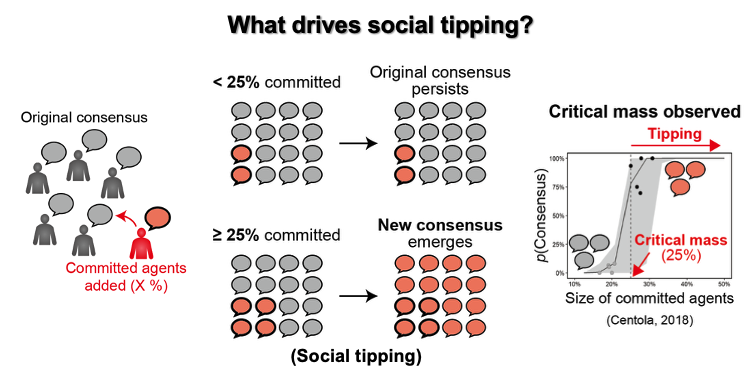
How do collective patterns of behavior arise in groups of animals and humans whose individual choices are noisy? At KIST, I build models in which simple stochastic individual behavior is enough to generate periodic cycles and spontaneous changes in social behavior at the population level, without any central coordination.
Representative work
- Spontaneous social tipping and trend cycles driven by randomness
Emergent cognitive functions in untrained neural networks
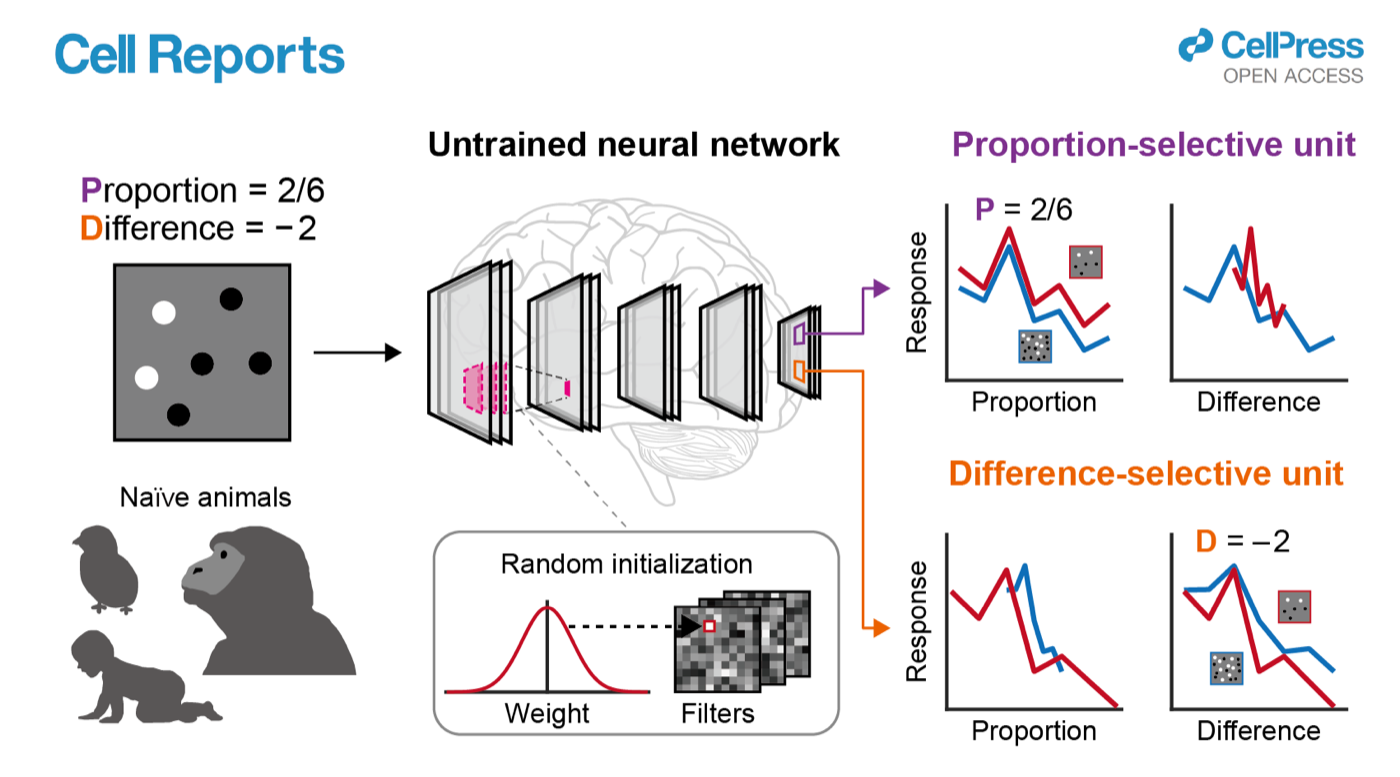
Newborn animals can compare visual quantities before any visual experience. Where does such an ability come from? Using biologically inspired model networks, I showed that single units selective to the proportion and the difference between two visual quantities emerge in randomly initialized feedforward circuits, and that these units are sufficient for the network to perform quantity comparison. A random summation of monotonic, nonlinear responses explains why two distinct kinds of tuning appear. The same approach extends to other innate functions, such as aesthetic preferences.
Representative work
Resource allocation in working memory and continual learning
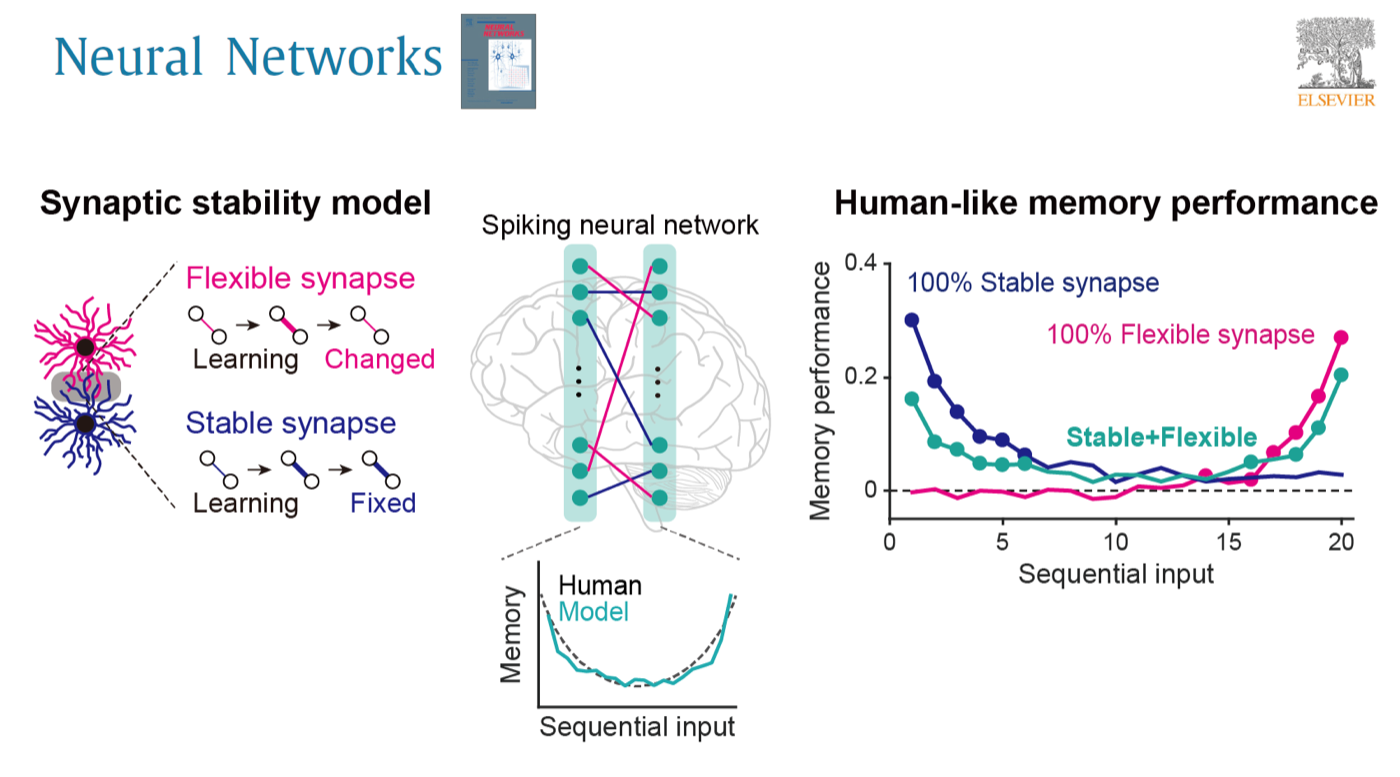
Working memory holds a sequence of items with limited resources, which produces the well-known serial-position effects. Combining human psychophysics with network models, I proposed that stable and flexible encodings take distinct roles in retaining and updating information, and that their balance can be controlled to modulate memory performance. Recently, we applied the same principle to artificial neural networks: a neuromimetic metaplasticity rule that mixes stable and flexible synapses lets a network learn new tasks without catastrophic forgetting.
Representative work
Neural data analysis
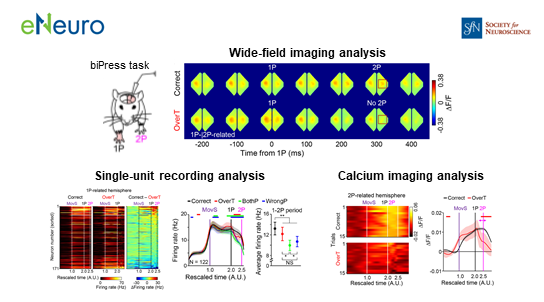
In collaboration with experimental labs, I analyze population recordings and imaging data to find how neural activity patterns relate to behavior. Examples include the cortico-cortical pathway that coordinates sequential bimanual movements in mice, distinct types of projection neurons that process working memory and timing in parallel, and a classification method for spatiotemporal activity patterns in brain imaging data.
Representative work